


A Journey Through Samyama
- Yogacharya Dr.Ananda Balayogi Bhavanani
- 15 hours ago
- 4 min read

This blog shares teachings from Guruji Rishiputra Balayogi Dr Anandaji on seven siddhis in Maharishi Patañjali's Yogasutras (III.23–29).
1. Yoga Sutra III.23 – Strength Through the Four Noble Attitudes
Maitryādiṣu Balāni
"Through samyama on friendliness, compassion, cheerfulness and equanimity comes strength."
Patañjali begins this series with perhaps the most practical of all siddhis. By performing samyama on the four noble attitudes—Maitri (friendliness), Karuna (compassion), Mudita (joy in the good of others), and Upeksha (equanimity)—the mind becomes purified (chitta prasadanam) and one develops profound inner strength (balam).
This is not merely emotional maturity but spiritual resilience. Such strength enables one to live in harmony with Dharma, face life's challenges with serenity, and steadily progress toward Kaivalya, the ultimate liberation.
Key Message:Right attitude → Pure mind → Inner strength → Spiritual evolution.

2. Yoga Sutra III.24 – Strength Through Samyama on Strength
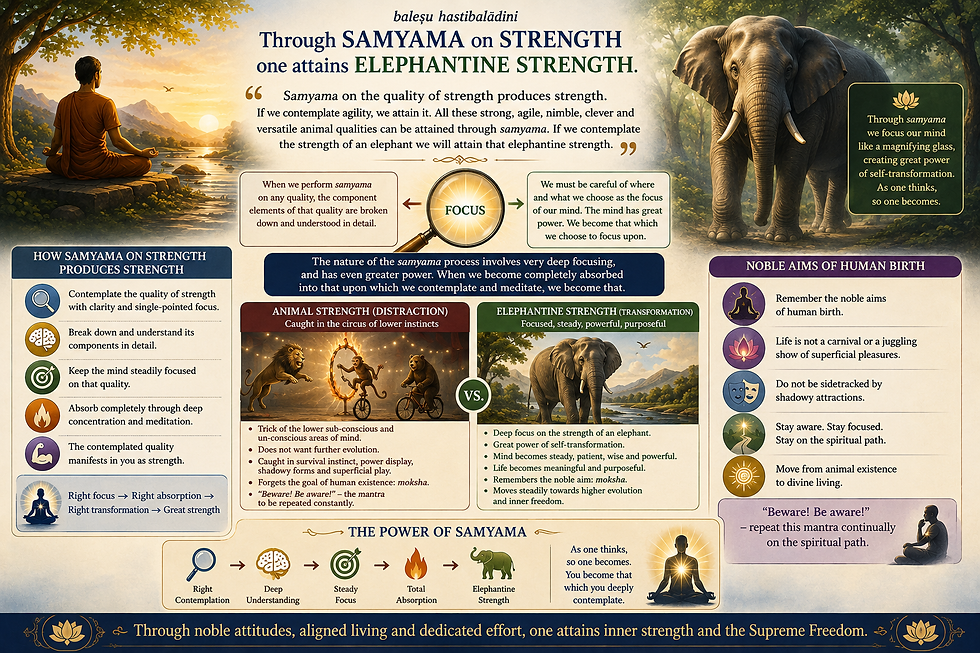
Baleṣu Hastibalādīni
"Through samyama on strength comes the strength of an elephant."
Having established inner moral strength, Patañjali next explains how focused contemplation transforms our very nature. By performing samyama on the quality of strength, one acquires the steadfastness, patience and immense power symbolized by the elephant.
This sutra illustrates one of Yoga's deepest psychological principles:
As one thinks, so one becomes.
Whatever quality we deeply contemplate gradually manifests within us. The mind becomes coloured by the object of meditation.
Key Message:Focused contemplation transforms character.
3. Yoga Sutra III.25 – Knowledge Through Inner Light
Pravṛttyāloka Nyāsāt Sūkṣma Vyavahita Viprakṛṣṭa-jñānam
"Through samyama on the inner light comes knowledge of the subtle, hidden and distant."
Here Patañjali introduces the awakening of inner perception. As consciousness becomes increasingly refined, one begins to perceive realities beyond the limitations of the physical senses.
This siddhi has traditionally been interpreted as clairvoyance. More importantly, it represents the development of profound intuitive insight, enabling one to perceive hidden truths, subtle relationships and deeper dimensions of reality.
The story of Hanuman beautifully illustrates this teaching: all divine powers already reside within us; Yoga simply helps us remember them.
Key Message:The greatest vision comes from awakening inner awareness.

4. Yoga Sutra III.26 – Knowledge of the Worlds Through the Sun
Bhuvana-jñānam Sūrye Samyamāt
"Through samyama on the sun comes knowledge of the worlds."
The Sun represents both the physical source of life and the inner light of consciousness.
Patañjali explains that contemplation on the sun reveals the various lokas or planes of existence. These are not merely geographical heavens and hells but differing levels of awareness.
The seven higher lokas symbolize progressively refined consciousness, while the lower lokas represent increasingly limited states of awareness. Every human being chooses, through attitude and understanding, the "world" in which they live.
Key Message:The outer sun sustains life; the inner sun awakens wisdom.

5. Yoga Sutra III.27 – Knowledge of the Constellations Through the Moon
Candre Tārāvyūha-jñānam
"Through samyama on the moon comes knowledge of the arrangement of the stars."
In yogic philosophy the moon symbolizes the mind.
The Purusha Sukta declares:
"Chandrama Manaso Jātah"The Moon arose from the Cosmic Mind.
Through contemplation of the moon we gain insight into the intricate relationship between our minds and the larger cosmic rhythms represented by the constellations (nakshatras). The sutra reminds us that understanding ourselves requires understanding the universe of which we are an integral part.
Key Message:The outer moon reflects the inner mind.

6. Yoga Sutra III.28 – Knowledge of Movements Through Dhruva
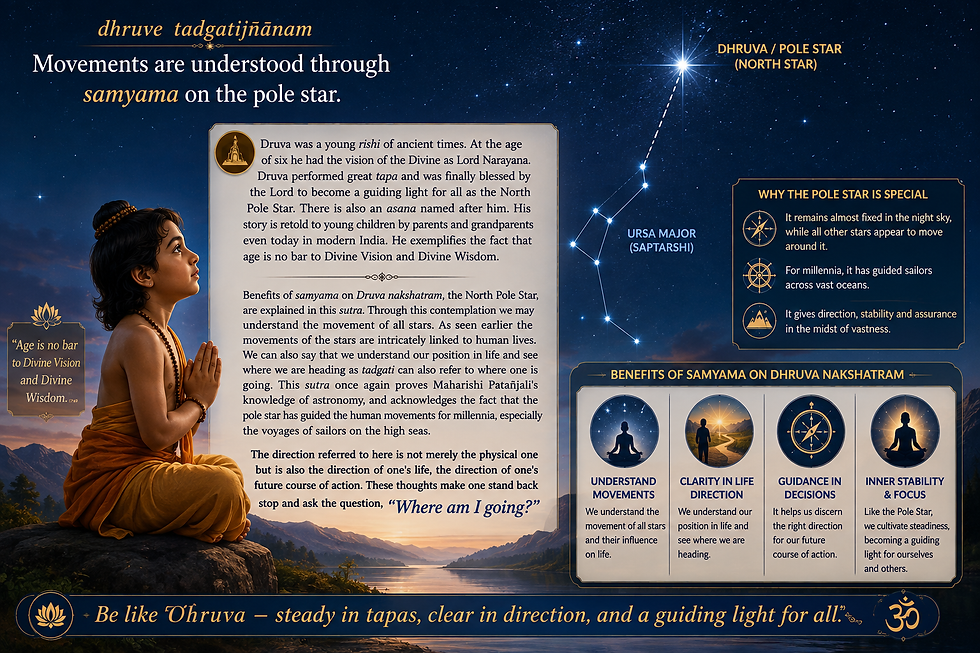
Dhruve Tadgati-jñānam
"Through samyama on the Pole Star comes knowledge of movements."
The Pole Star has guided travellers for thousands of years because of its apparent stability.
Likewise, the story of young Dhruva teaches unwavering determination, steadfast devotion and absolute clarity of purpose.
Patañjali explains that contemplation upon this fixed celestial point reveals movement—not only of the stars but also the direction of our own lives.
It invites every seeker to ask:
"Where am I going?"
When the inner centre becomes steady, all movements around us become understandable.
Key Message:A stable centre brings clarity to life's journey.
7. Yoga Sutra III.29 – Knowledge of the Body Through the Navel Centre
Nābhicakre Kāyavyūha-jñānam
"Through samyama on the navel centre comes knowledge of the arrangements of the body."
The sequence concludes by returning inward to the Manipura Chakra, the body's centre of vitality and transformation.
The navel is where life first develops through the umbilical connection. Ancient yogis recognized it as the seat of Samana Vayu, the integrating force responsible for nourishment, balance and transformation.
By meditating on this centre, one understands not only the structure of the physical body but also the profound unity of body, energy and consciousness.
The symbolism of Lord Vishnu reclining upon the cosmic ocean while Lord Brahma emerges from the lotus arising from His navel beautifully expresses the principle that creation arises from perfect inner stability.
Key Message:The navel is the body's centre of integration, vitality and creation.

Conclusion
These seven sutras describe a remarkable progression. Patañjali begins with purifying the heart through noble attitudes, develops strength and inner perception, expands awareness to embrace the cosmos, and finally returns inward to the human body, revealing the profound unity of the microcosm and the macrocosm.
The siddhis are therefore not isolated supernatural powers. They represent successive stages in the expansion of consciousness through samyama, reminding us that the true goal of Yoga is not extraordinary abilities, but the realization of our highest potential and, ultimately, Kaivalya—the Supreme Freedom.


Comments