


Exploring the Opening Teachings of the Kaivalyapada

(Yoga Darshana IV.1–IV.6)
The opening sutras of the Kaivalyapada take us beyond extraordinary yogic powers into the deeper science of transformation. While the chapter begins by acknowledging the existence of siddhis, Patanjali immediately redirects our attention toward the real purpose of yoga—the complete evolution of consciousness culminating in Kaivalya, absolute freedom. These six sutras reveal how nature unfolds, how transformation occurs, how the ego creates countless false identities, and how meditation ultimately restores the mind to its original purity.
Siddhis: Powers Along the Yoga Path
Patanjali begins the final chapter by explaining that siddhis, or extraordinary abilities, may arise through five different means: birth (janma), herbs (aushadhi), mantra, austerity (tapas), and deep meditative absorption (samadhi). Throughout India's spiritual traditions there are countless examples of individuals possessing remarkable abilities through one or more of these avenues. Yet Patanjali immediately cautions us not to mistake these powers for the goal of yoga.
Siddhis are merely by-products of inner development. They may include heightened perception, healing abilities, extraordinary knowledge, or other unusual capacities, but attachment to them can become a subtle obstacle on the spiritual path. True yogic maturity lies not in displaying powers but in transcending fascination with them.
The sincere seeker understands that every gift carries responsibility. When siddhis appear naturally, they should be used only with humility, compassion, and discrimination for the welfare of all beings, never for personal recognition or egoic gratification. Yoga ultimately seeks liberation from identification with all phenomena—including extraordinary experiences. The highest attainment is not miraculous power but abiding Self-realization. Thus Patanjali places siddhis in their proper perspective: fascinating milestones on the journey, yet never the destination itself.
Nature's Evolution Towards Completeness
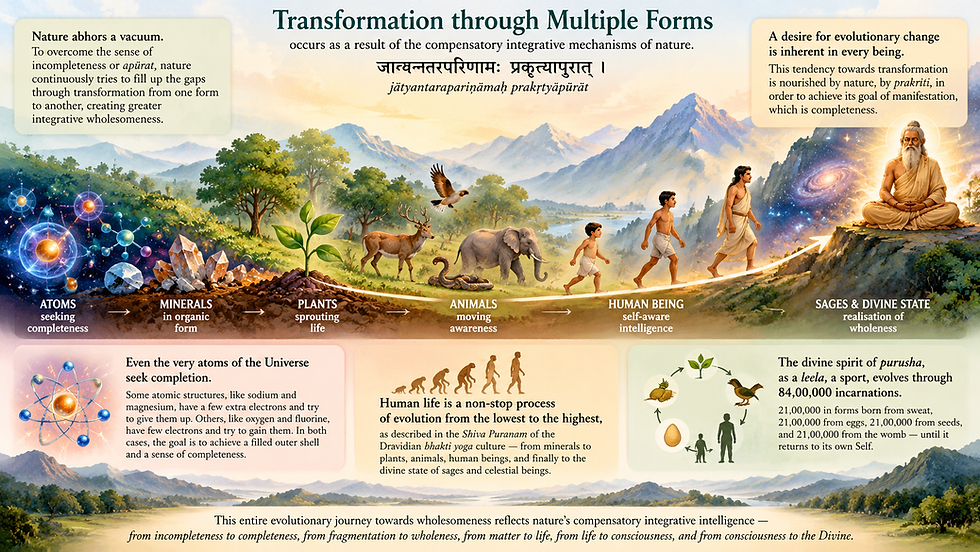
The second sutra introduces one of the most profound principles of Yoga philosophy: transformation occurs because nature continuously strives toward greater completeness. Every level of existence possesses an innate urge to evolve. From the smallest atom seeking stability, through minerals, plants, animals, human beings, sages, and ultimately divine realization, life unfolds according to the intelligent movement of Prakriti.
Nature dislikes fragmentation. Wherever there is incompleteness, compensatory forces arise to restore balance, integration, and wholeness. Evolution therefore is not accidental but an expression of nature's intrinsic intelligence. Human spiritual growth is simply the highest expression of this universal law.
Ancient traditions describe countless forms through which consciousness journeys before realizing its essential divine nature. Each stage provides experiences necessary for further refinement. Every challenge, relationship, and circumstance becomes part of this evolutionary process.
Yoga harmonizes us with this natural movement rather than opposing it. When we cooperate with Prakriti instead of resisting it, growth becomes effortless. Spiritual practice accelerates this unfolding by removing unnecessary resistance and allowing our innate potential to manifest. Ultimately, the journey is one from apparent incompleteness to perfect wholeness—from matter to life, life to awareness, awareness to wisdom, and wisdom to realization of the eternal Self.
Removing Obstacles to Transformation
Patanjali explains that spiritual practices do not directly create enlightenment; rather, they remove the obstacles preventing our natural evolution. He compares the yogi to a farmer who opens irrigation channels. The farmer does not make the water flow—the water already possesses that tendency. He simply removes the barriers.
Similarly, asana, pranayama, ethical living, meditation, and self-discipline clear away ignorance, tension, habitual conditioning, and psychological limitations. True education is therefore not about adding knowledge but uncovering the wisdom already present within us. Every sincere practice prepares the mind for greater clarity by eliminating what obscures our true nature.
Transformation is thus a cooperative process between human effort and nature's intelligence. Our responsibility is to cultivate the field; nature performs the miracle of growth. Yoga becomes the science of removing obstruction rather than manufacturing perfection.
The Created Mind and the Ego
Patanjali teaches that the ordinary mind arises from asmita, the sense of "I-am-ness" or individuality. The ego constructs countless mental identities, roles, memories, fears, desires, and opinions until we become trapped within a maze of our own creation. These many "created minds" are not our true nature but temporary psychological constructions.
The universal mind remains pure and undivided, yet ignorance fragments experience into "my mind" and "your mind." This mistaken identification gives rise to suffering and confusion.
Yoga cultivates discernment (viveka) so that we gradually distinguish the finite created mind from the infinite causal consciousness. As awareness deepens, we cease identifying with the changing mental patterns and begin recognizing the unchanging witness. Freedom begins when we understand that the ego is a useful instrument, but never our true identity.
The One Mind Behind the Many
Although countless individual minds appear different, Patanjali explains that they are all directed by one underlying causal consciousness. Just as many boats may sail upon the same ocean while following different courses, every individual expresses the same universal intelligence through unique thoughts, emotions, perceptions, and actions.
Problems arise when the ego imagines itself to be completely independent and attempts to dominate life. This illusion creates conflict, fear, and suffering. The individual mind forgets its source and behaves as though it alone governs existence.
Yoga restores humility by reminding us that every thought, action, and creative expression ultimately emerges from the One Consciousness. Recognizing this unity dissolves arrogance while fostering compassion and interconnectedness. The diverse activities of countless minds are simply different expressions of one infinite reality working through many forms.
The Mind Born of Meditation
Patanjali concludes this sequence by describing the mind purified through dhyana. Unlike the ordinary conditioned mind, the meditative mind becomes free from accumulated impressions, distortions, and habitual reactions. Meditation does not create something new; it reveals the mind in its original clarity.
Past experiences and karmic tendencies usually cloud perception, causing us to interpret reality through the filters of conditioning. Consistent awareness gradually dissolves these impressions, allowing reality to be perceived as it IS.
Preparation for Dhyanam includes disciplined living, self-observation, ethical conduct, and patient practice. As the mind becomes increasingly transparent, higher states of consciousness naturally unfold. The purified mind reflects truth without distortion, making liberation possible.
Thus Patanjali presents meditation as the culmination of the yogic process—a state where awareness is no longer governed by past conditioning but rests in the freedom and luminosity of pure consciousness.
These six sutras beautifully establish the direction of the Kaivalyapada. Patanjali begins by acknowledging the existence of extraordinary powers but immediately shifts our attention toward the deeper process of spiritual evolution. Nature itself guides every being toward wholeness, while yoga assists this unfolding by removing the obstacles created through ignorance, ego, and conditioning.

The journey progresses from recognizing the limitations of the created mind to discovering the one universal consciousness that underlies all individual experience. Finally, through meditation, the mind becomes purified of accumulated impressions and reflects reality as it truly is. The emphasis throughout is not on acquiring new abilities but on uncovering what has always been present beneath layers of mental conditioning.

In this way, the opening teachings of the Kaivalyapada remind every sincere seeker that the true miracle of yoga is not the attainment of siddhis but the realization of one's eternal nature. Extraordinary experiences may arise along the path, but they remain secondary to the supreme goal: abiding in the freedom, clarity, and completeness of the Self.


Comments