


Marmanasthanam Kriya & the Somato-Cognitive Action Network
- Yogacharya Dr.Ananda Balayogi Bhavanani
- Jun 24
- 1 min read

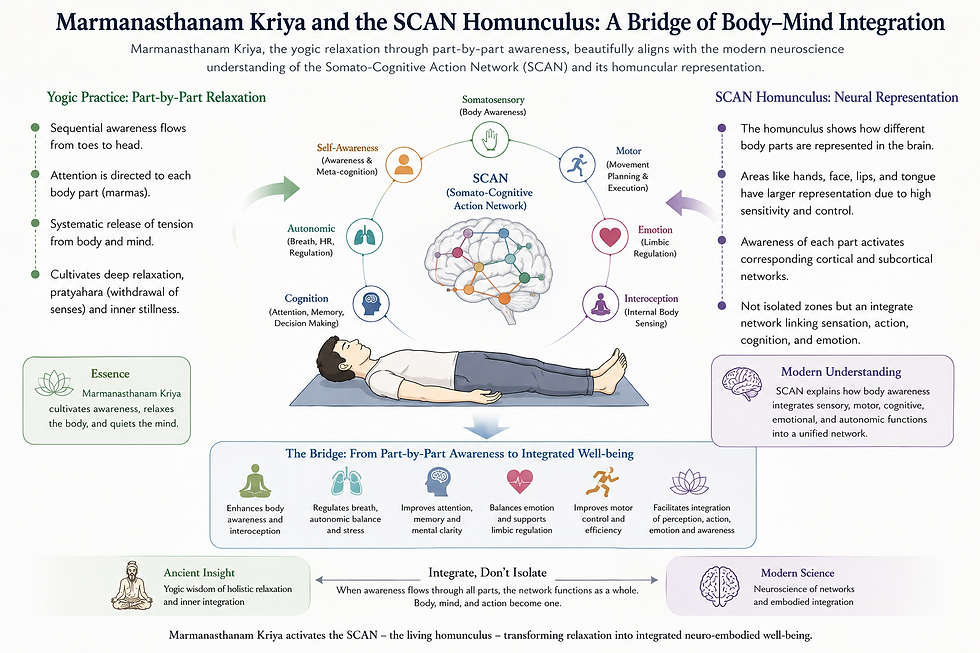
Marmanasthanam Kriya, the classical yogic practice of systematic part-by-part relaxation, offers a profound experiential bridge to the modern neuroscientific understanding of the Somato-Cognitive Action Network (SCAN).
In this yogic practice, awareness is consciously moved through different regions of the body, relaxing each area while cultivating heightened interoception, breath awareness, and mental stillness.
Traditionally, this process was understood as harmonizing the body, mind, prana, and consciousness through integrated awareness.
Modern neuroscience now recognizes similar principles through the SCAN model, which describes how bodily sensation, movement, cognition, emotional regulation, and self-awareness are interconnected within dynamic neural networks.

Unlike the older Penfield homunculus model that viewed body representation in isolated cortical segments, the SCAN framework emphasizes integration rather than separation. It recognizes that the brain functions through coordinated networks linking sensory perception, autonomic regulation, emotional processing, attention, and intentional action.
The yogic practice of sequential body awareness mirrors this integrative neurophysiological process. As attention flows from one body region to another during Marmanasthanam Kriya, cortical mapping, interoceptive awareness, autonomic calming, and cognitive-emotional regulation are simultaneously engaged.
This may help explain the deep relaxation, emotional balance, and heightened clarity experienced in such practices.
Thus, ancient yogic wisdom and modern neuroscience converge in demonstrating that healing and wellbeing arise not through isolating body parts or mental functions, but through cultivating an integrated body-mind network — truly embodying the principle:
“Integrate, do not isolate.”


Comments