


Yoga & Diabetes: Reclaiming Health Through a Yogic Way of Life

Diabetes mellitus has become one of the defining lifestyle disorders of our age. Despite remarkable advances in medical science, the number of people affected continues to rise, reminding us that medication alone can never solve a problem whose roots lie deep within the way we live, think, breathe, eat, and respond to life.
Yoga offers us a different perspective. It does not merely ask, "How do we control blood sugar?" Rather, it asks, "How do we restore harmony to the whole human being?" This shift in perspective is the essence of Yoga Therapy. We move from treating disease to cultivating health—from pathogenesis to salutogenesis, the creation of wellbeing.
For thousands of years, Yoga has taught that true health is a dynamic balance of body, emotions, mind and spirit. Diabetes is therefore not viewed simply as a disorder of glucose metabolism, but as a manifestation of deeper disturbances in lifestyle, stress, diet, emotions, and energy regulation. When these are corrected, the body's own remarkable healing intelligence begins to express itself.
Understanding Diabetes Through Yogic Eyes
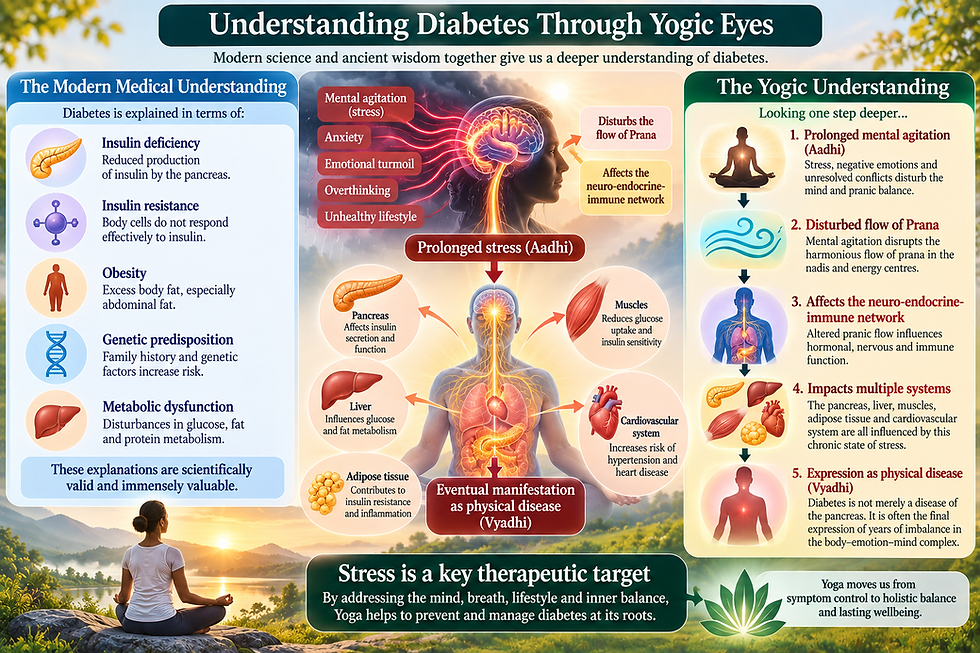
Modern medicine explains diabetes in terms of insulin deficiency, insulin resistance, obesity, genetic predisposition and metabolic dysfunction. These explanations are scientifically valid and immensely valuable.
Yoga accepts these mechanisms while looking one step deeper.
According to the yogic understanding, prolonged mental agitation (aadhi) disturbs the harmonious flow of prana. This disturbed pranic flow alters the functioning of the neuro-endocrine-immune network, eventually expressing itself as physical disease (vyadhi). The pancreas, liver, muscles, adipose tissue and cardiovascular system are all influenced by this chronic state of stress.
Thus, diabetes is not merely a disease of the pancreas. It is often the final expression of years of imbalance in the body-emotion-mind complex.
Stress therefore becomes one of the most important therapeutic targets.
The Scientific Evidence
One of the most satisfying developments over the past three decades has been the growing body of scientific evidence validating what yogis have known intuitively for centuries.
Research has demonstrated that Yoga is far more than a system of physical exercise. It produces measurable psycho-physiological changes that influence metabolism, autonomic balance, endocrine function and emotional wellbeing.
Even a brief nine-day lifestyle modification programme based on Yoga has been shown to reduce major risk factors for cardiovascular disease and diabetes. Systematic reviews have consistently demonstrated improvements in body weight, blood pressure, blood glucose and serum cholesterol following yogic interventions.
Long-term yoga practitioners exhibit greater insulin sensitivity and healthier relationships between body weight, waist circumference and glucose metabolism. Other studies have demonstrated improvements in nerve conduction, reaction time, biochemical parameters and overall quality of life in individuals living with diabetes.
One of our own studies conducted at Sri Balaji Vidyapeeth evaluated a structured Integrated Yoga Therapy Protocol in individuals with Type 2 Diabetes Mellitus over 120 days. Participants who practiced yoga in addition to standard medical care showed significant improvements in body mass index, fasting and post-prandial blood glucose, HbA1c, insulin resistance (HOMA-IR), cholesterol, triglycerides, LDL cholesterol and several other metabolic parameters compared to controls receiving conventional treatment alone. The study concluded that integrated yoga therapy serves as an effective, safe and valuable adjuvant in diabetes management.
These findings beautifully reinforce an important truth: Yoga complements medicine—it does not compete with it.

An academic review of Yoga in Diabetes Mellitus based on various studies by Dr AB Bhavanani & colleagues at Pondicherry is available for free download from https://www.academia.edu/176499594/The_Role_of_Yoga_in_the_Management_of_Diabetes_MellitusWhy Does Yoga Work?
The therapeutic mechanisms of Yoga are both simple and profound.
Controlled breathing, mindful movement, meditation and deep relaxation activate the parasympathetic nervous system while reducing excessive sympathetic activity—the classic "fight or flight" response responsible for chronic elevations in stress hormones.
As cortisol and adrenaline decrease, blood glucose regulation improves naturally.
Gentle stretching enhances circulation to the pancreas and other abdominal organs while improving muscular glucose uptake. Weight gradually reduces, insulin sensitivity improves and inflammatory processes become less active.
Equally important are the emotional changes.
A person who begins Yoga often develops greater self-awareness, improved dietary discipline, emotional stability and a renewed sense of responsibility towards health. Compliance with medication improves. Lifestyle becomes healthier. Relationships improve.
These changes cannot be measured by a glucometer, yet they often determine long-term success.

The Yogic Principles of Diabetes Management
Yoga Therapy is never limited to postures alone.
Its foundation rests upon four essential principles.
The first is psychological reconditioning. Through Yama, Niyama, Chatur Bhavana and Pratipaksha Bhavanam we cultivate healthier attitudes towards ourselves, our relationships and life's challenges. Negative emotional patterns gradually give way to acceptance, moderation, gratitude and self-discipline.
The second principle is stress management through counselling, jathis, kriyas, asanas and pranayama. Rather than suppressing stress, Yoga teaches us to modify our perception of stressors, optimise our responses and efficiently release accumulated tension.
The third principle is enhancing glucose utilisation through appropriate physical activity. Surya Namaskar, dynamic kriyas and carefully selected asanas increase muscular glucose uptake while improving metabolism and supporting healthy weight management.
The fourth principle is deep relaxation and meditation, allowing the body to shift into its natural healing mode. Relaxation is not laziness—it is intelligent physiological recovery.
Together these four principles transform Yoga from exercise into true therapy.

The Yogic Lifestyle
No yoga programme for diabetes can succeed without corresponding lifestyle transformation.
Regular walking remains one of the simplest and most effective daily practices. Swimming, gentle aerobic exercise and appropriate physical activity complement yoga beautifully.
Diet should consist of small, regular meals built around complex carbohydrates, whole grains, fresh vegetables, sprouts, leafy greens and fibre-rich foods. Refined sugars, processed foods and excessive fats should be avoided. Traditional foods such as bitter gourd, neem and adequate hydration further support metabolic balance. Sitting quietly in Vajrasana for a few minutes after meals assists digestion and assimilation.
Yoga reminds us that ahara is not merely what enters the mouth. Everything we consume through our senses influences our health.
Yogic Practices for Diabetes
An integrated Yoga Therapy programme includes a carefully graded sequence adapted to the individual's age, fitness and medical condition.
Surya Namaskar helps improve metabolism and glucose utilisation.
Twisting postures such as Vakrasana, Ardha Matsyendrasana and Trikonasana gently massage the abdominal organs while improving spinal flexibility.
Abdominal pressure postures including Pavanamuktasana, Navasana, Bhujangasana and Dhanurasana stimulate digestive and pancreatic functions.
Inverted practices like Viparita Karani, when appropriately prescribed, support metabolic regulation.
Pranayama forms the heart of the programme. Vibhaga Pranayama, Pranava Pranayama, Chandra Nadi, Nadi Shuddhi, Savitri Pranayama and carefully supervised Kapalabhati help restore autonomic balance while reducing stress.
Relaxation practices such as Shavasana, Kaya Kriya, Marmanasthanam Kriya and Yoga Nidra allow profound psycho-physiological restoration.
Meditative practices including Om Japa, Ajapa Japa, Prana Darshana and Chakra Dharana centred on Manipura Chakra cultivate inner steadiness and resilience.

More Than Blood Sugar
Perhaps the greatest contribution of Yoga is that it changes the patient's relationship with illness.
Instead of becoming fearful of diabetes, one becomes empowered.
Instead of depending entirely upon external treatment, one actively participates in one's own healing.
Instead of seeing health as the absence of disease, one begins experiencing it as balance, vitality and inner harmony.
Yoga empowers individuals to take responsibility for their own wellbeing while working harmoniously alongside their physician and medical treatment. This integrated approach represents the future of healthcare.
A Final Reflection
Many people ask me whether Yoga can cure diabetes.
My response is always the same.
Yoga is not a miracle pill. It is a way of life.
If practiced occasionally, its benefits will also be occasional.
If practiced sincerely, patiently and consistently, Yoga becomes a lifelong companion that transforms every aspect of health. Blood sugar improves, certainly—but so do sleep, digestion, emotional stability, cardiovascular health, energy levels, resilience and quality of life.
The real gift of Yoga is not merely a lower HbA1c.
Its true gift is the rediscovery of balance.
As my revered Guru, Yogamaharishi Dr. Swami Gitananda Giri Guru Maharaj, so beautifully reminded us:
"Health and happiness are your birthright. Learn and live Yoga, for then you will know true health and happiness."


Comments